
A Samsung screen grade does not tell you how much installation work arrives with the part. The same model and grade may be offered with a compatible middle frame already assembled or as a display-only replacement that must be bonded to the phone’s existing frame. That difference affects technician workflow, tooling, rework exposure, and receiving inspection.
When I review a Samsung buying list, I make frame configuration a required column rather than a note added after the quote. A line that says “S23 Ultra refurbished” is incomplete. It should say whether the buyer wants Original Refurbished with frame or without frame, and whether any substitution is acceptable.
There is no universal default. Galaxy A models that originally use incell LCD can favor without-frame when the old frame is reusable. Aftermarket OLED, especially Galaxy S and Note, normally favors with-frame. Panel family and grade must come first.
What Is the Physical Difference Between With Frame and Without Frame?
When I explain this choice to a purchasing team, I start with the work that has already been completed before the part reaches the repair bench. That makes the distinction clearer than supplier shorthand.
Short answer: a with-frame screen is already installed into a compatible middle frame; a without-frame screen is the display assembly alone1 and must be fitted to the phone’s existing frame.
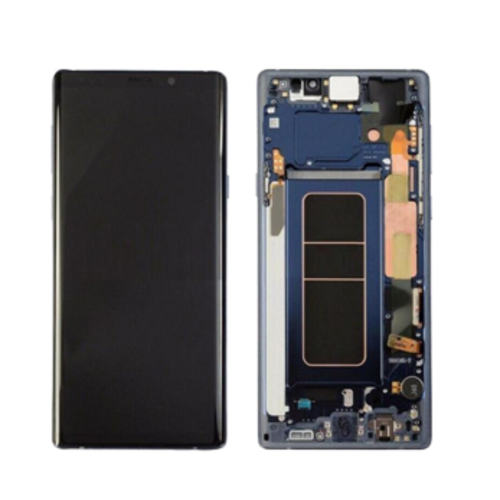
A with-frame unit moves the repair toward component transfer and final assembly. The technician still verifies the model, inspects the assembly, transfers applicable parts, manages seals or adhesives, and tests the phone. However, display-to-frame bonding has already been performed.
A without-frame unit starts earlier. The damaged display must be separated with controlled heat2, and residual glass and adhesive removed without deforming the frame. The replacement then needs alignment, bonding, and testing.
| Work step | With frame | Without frame |
|---|---|---|
| Display already bonded to a middle frame | Yes | No |
| Old display separation from original frame | Usually avoided | Required |
| Original frame cleaning and preparation | Limited | Required |
| Display-to-frame alignment | Performed before delivery | Performed by repair bench |
| Component transfer and final phone assembly | Required | Required |
| Pre-installation display and touch test | Required | Required |
The words “with frame” also need model-level confirmation. A frame can carry color, antenna, bracket, button, or regional differences. I ask for the exact phone model and required frame detail instead of treating every frame attached to a screen as interchangeable.
Why Does Frame Configuration Matter So Much for Samsung Repairs?
When I compare Samsung and iPhone procurement, I see frame configuration appear more consistently in Samsung screen lists. Samsung’s range includes many curved-edge and large OLED assemblies where heat control, alignment, and edge bonding demand a disciplined process.
Short answer: the combination of curved displays, adhesive construction, and broad model variation makes display-to-frame work a meaningful source of labor and installation risk.
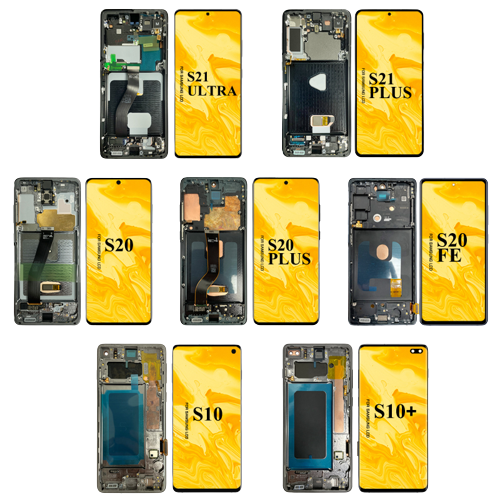
A curved panel leaves less tolerance for uneven support or poor edge alignment. Excess heat, incomplete cleaning, or a distorted original frame can turn a good incoming screen into an installation problem. Galaxy S and Note screens can also be thin as well as curved. A correctly paired frame supports the panel around its shape during handling and shipment, although proper trays and outer packaging are still required.
The effect appears clearly in current customer choices, but the percentages only make sense after incell and OLED are separated. I show that split later rather than using one misleading Samsung-wide ratio.
What Hidden Costs Come With a Samsung Screen Without Frame?
When I compare two quotations, I map every step required to reach a tested, sellable repair. A lower display-only line price can be real, but it does not automatically produce a lower installed cost3.
Short answer: the hidden costs are technician time, separation and bonding equipment, consumables, frame-condition uncertainty, rework, and the value of a repair slot.

Frameless repair adds separation, cleaning, alignment, bonding, equipment, and consumables. It also assumes the original middle frame is straight and reusable; impact damage may remain hidden until removal4. I ask each operation to measure its own process time and rework by model instead of borrowing a universal failure-rate number.
The equation changes for a flat Galaxy A model that originally uses an incell LCD. The screen-only part is low in value relative to a complete assembly, fitting it into a sound old frame is comparatively straightforward for a trained bench, and reusing that frame avoids unnecessary material waste5. In that case, without-frame is not merely a cheaper-looking line; it can be the better process choice.
Dust, uneven adhesive, edge lift, poor alignment, flex damage, or panel pressure can still spoil a good incoming screen. I keep supplier defects separate from installation damage so the team knows whether a batch or bench needs correction.
When Does a Without-Frame Screen Make Commercial Sense?
When I recommend a frameless configuration, I first separate original-spec incell, aftermarket OLED, and refurbished original-panel grades. The same technician and old frame do not carry the same risk across those three groups.
Short answer: without-frame is a strong consideration for compatible Galaxy A incell models with a sound reusable frame. For Hard OLED or Soft OLED, it should be a controlled choice for a skilled bench; with-frame remains the normal recommendation.

A specialized refurbishment line can inspect frames, control adhesives, maintain fixtures, and record outcomes by model. That capability makes the strongest case for without-frame Galaxy A incell screens.
Hard OLED and Soft OLED need a different default. A skilled technician can install a screen-only aftermarket OLED6, but the paired frame supplied by the screen assembler is chosen around that panel's geometry and fit. I normally recommend with-frame because it reduces the chance that an old frame or an imperfect bonding setup works against the OLED assembly.
For flat Galaxy A Original Refurbished or other original-panel grades, with-frame and without-frame can both be workable. The decision can follow the buyer's bench process and the condition of the reusable frame. For Galaxy S and Note, I hold with-frame as the strong default7 because curve, panel thinness, old-frame deformation, installation skill, replacement cost, and transport exposure all compound the risk.
What Does Current Samsung Buyer Behavior Suggest?
When I review frame requests, I no longer use one series-level percentage without separating the original panel family and grade. Galaxy A alone contains two very different buying patterns.
Short answer: current Galaxy A incell purchases favor without-frame, about 78% of Galaxy A OLED purchases choose with-frame, and more than 95% of Galaxy S and Note purchases choose with-frame. These signals guide the recommendation but do not replace an exact model check.
| Screen family and grade | Current buyer signal | Procurement recommendation |
|---|---|---|
| Galaxy A original-spec incell LCD | Current purchases are predominantly without frame | Consider without-frame when the old frame is straight and the bench controls bonding |
| Galaxy A Hard OLED or Soft OLED | About 78% of current purchases choose with frame | Recommend with-frame normally; screen-only is for technicians with a controlled OLED process |
| Galaxy A Original Refurbished or other original-panel grades | Both formats are practical | Choose by old-frame condition, workflow, and exact model availability |
| Galaxy S and Note | More than 95% of current purchases choose with frame | Strongly prefer with-frame for curved or thin panels, fit control, and transport support |
| Galaxy Z | Foldable-specific assembly sourcing | Confirm the exact Fold or Flip generation and assembly; do not apply a flat-screen rule |
These are current FIZON buying patterns, not universal percentages or stock promises. “Galaxy A” does not produce one answer: incell LCD, aftermarket OLED, and refurbished original-panel grades lead to different recommendations. Galaxy S and Note produce a much stronger with-frame default, while Galaxy Z remains foldable-specific. For current model coverage, use Samsung screen wholesale and confirm live availability.
What Four Questions Should a Buyer Ask Before Ordering?
When I convert an inquiry into a purchase-ready list, I ask four questions in a fixed order. This removes most frame-related ambiguity before the supplier prepares the final offer.
Short answer: confirm exact model, assembly contents, grade-frame pairing, and substitution rules.
- What is the exact model, variant, and original display family? Identify incell LCD, flat AMOLED, curved OLED, or foldable construction.
- What grade is being ordered? Keep Original Refurbished, Soft OLED, Hard OLED, incell, and TFT separate.
- Is the old frame straight and suitable for this bench? Success with flat A-series incell does not prove the team should bond a thin curved S/Note OLED.
- What is included, and what if the format is unavailable? Confirm small parts and require every substitution to be quoted separately.
I add two receiving controls after those questions. First, pre-test the display and touch before final installation8. Second, keep supplier batch identity and technician repair notes separate so that any issue can be traced to incoming product, shipping damage, frame condition, or installation handling.
For the grade definitions behind this decision, use the planned hub guide Samsung screen grades explained. The hub and this frame guide should be read together: one defines the display category, and the other defines how much assembly work accompanies it.
Conclusion
With-frame versus without-frame is not one Samsung-wide rule. It is a decision about the original panel family, replacement grade, reusable-frame condition, technician process, transport exposure, and value at risk.
I start Galaxy A incell models from a without-frame discussion when the old frame is sound. I normally recommend a paired frame for Hard OLED and Soft OLED, while flat A-series refurbished original-panel grades can work in either format. For Galaxy S and Note, with-frame is the strong default because curve, thinness, fit, installation damage, and shipping support matter at the same time.
Frequently Asked Questions
Is a Samsung screen with frame ready to install?
It is more installation-ready because the display is already bonded to a compatible middle frame, but work remains. The technician must still pre-test it, transfer applicable components, manage seals or adhesives, assemble the phone, and complete final testing.
Does with frame mean the screen grade is better?
No. Grade and frame are separate fields. Original Refurbished, Soft OLED, Hard OLED, incell, or TFT may have different frame options by model. A frame changes installation scope, not the panel’s source or construction.
Should Galaxy A incell screens be ordered without frame?
They are a strong candidate for without-frame purchase. The screen-only assembly is comparatively low in value, fitting a flat incell panel into a sound reusable frame is manageable for a trained bench, and reusing the old frame avoids unnecessary waste. Inspect the frame before making this the default.
Should Hard OLED and Soft OLED screens be ordered with frame?
Usually, yes. A capable technician can install a screen-only aftermarket OLED, but the frame paired by the screen assembler is selected to fit that panel construction. With-frame is the safer normal recommendation; without-frame should be a controlled exception for a bench with strong OLED installation capability.
Why are Galaxy S and Note screens usually ordered with frame?
More than 95% of our current S and Note purchases choose with frame. Curved, thin assemblies require careful heat control, surface preparation, edge alignment, and uniform bonding; an old frame may also be distorted. The frame supports the panel during handling and shipment as well as reducing installation exposure.
When should a repair chain buy without-frame screens?
Start with compatible Galaxy A incell models where trained technicians, reusable frames, recurring model volume, and measured rework results support the process. Extend screen-only purchasing to OLED only when the bench has controlled heating, alignment, and bonding capability. Do not copy the incell rule to Galaxy S or Note.
What should be confirmed about a Samsung frame before ordering?
Confirm the exact model and variant, frame color, included brackets or small parts, grade paired with the frame, and whether substitutions are allowed. Ask for current availability rather than relying on an old catalog ratio.
"UDC-VIT: A Real-World Video Dataset for Under-Display Cameras", https://arxiv.org/html/2501.18545v1. Technical repair documentation distinguishes display assemblies supplied with a replacement midframe from display-only assemblies that must be transferred to the handset’s original frame. Evidence role: definition; source type: education. Supports: A technical repair guide should define a framed display assembly as a screen already mounted to a replacement chassis or midframe and a frameless assembly as a screen requiring transfer to the existing frame.. Scope note: Terminology and included components can vary by Samsung model and supplier. ↩
"How to Transfer IC Chips for Perfect iPhone Screen Repairs - FIZON", https://fizonparts.com/how-to-transfer-the-ic-to-the-new-iphone-screen/. Technical literature on bonded mobile-device displays describes controlled heating as a method for softening adhesive during screen separation while reducing the risk of thermal or mechanical damage. Evidence role: mechanism; source type: research. Supports: Research or technical service literature should explain that heat softens bonding adhesives during display separation and that temperature control is used to limit damage to the panel, frame, and nearby components.. Scope note: The appropriate temperature, tools, and procedure are device-specific and should not be generalized across all Samsung models. ↩
"[PDF] A New Test/Diagnosis/Rework Model for Use in Technical Cost ...", http://escml.umd.edu/Papers/ITC_Test_Econ.PDF. Repair-cost analyses treat the purchase price of a component as only one part of installed cost, with labor, consumables, equipment utilization, and rework contributing to the total. Evidence role: general_support; source type: research. Supports: A repair-operations or cost-accounting study should support evaluating component price together with labor, consumables, equipment use, rework, and throughput costs.. Scope note: The relative cost of framed and frameless Samsung repairs depends on local wages, equipment, technician skill, and measured process times. ↩
"Affordable iPhone Screen Replacement: Fast & Reliable Repair Guide", https://imba.missouri.edu/iphone-screen-repalce-1858953276.html. Mobile-device repair guidance treats frame inspection after screen removal as necessary because deformation or impact damage can affect the fit and bonding of a replacement display. Evidence role: general_support; source type: education. Supports: Repair documentation should describe inspection of the chassis or midframe after display removal and identify deformation as a possible cause of poor fit or bonding.. Scope note: The frequency and detectability of concealed frame damage depend on the severity and location of the original impact. ↩
"Comparative life cycle assessment of smartphone reuse", https://www.ece.ucdavis.edu/~ramirtha/recentPubs/zinkFinalJLCA.pdf. Circular-economy assessments generally find that repair and reuse can reduce material demand and electronic waste relative to premature replacement of otherwise serviceable components. Evidence role: general_support; source type: institution. Supports: An environmental or circular-economy source should support the general proposition that extending component life and avoiding unnecessary replacement can reduce resource use or electronic waste.. Scope note: This general lifecycle finding does not quantify the environmental benefit of reusing a particular Samsung frame. ↩
"Aftermarket vs Original iPhone Screen Quality - FIZON", https://fizonparts.com/everything-you-should-know-about-iphone-replacement-screen-quality-aftermarket-vs-original-for-repair-shops-wholesalers/. Display-refurbishment training materials describe screen-only OLED installation as a feasible procedure when technicians use controlled separation, alignment, adhesive application, and curing methods. Evidence role: general_support; source type: education. Supports: A technical training or refurbishment source should document the tools, alignment, adhesive, and handling steps required to install a screen-only OLED assembly.. Scope note: Feasibility does not establish a uniform success rate, and procedures differ among OLED constructions and handset models. ↩
"(PDF) A study on the optimum curvature for the curved monitor", https://www.academia.edu/112312929/A_study_on_the_optimum_curvature_for_the_curved_monitor. Technical repair literature supports treating curved and thin OLED assemblies as more process-sensitive during alignment, bonding, and handling, which provides contextual support for preferring a preassembled frame. Evidence role: general_support; source type: research. Supports: Technical and repair research should support the relationship between curved or thin OLED assemblies, bonding precision, handling requirements, and installation risk.. Scope note: The evidence supports the risk rationale but does not prove that with-frame is optimal for every Galaxy S or Note model, technician, or cost structure. ↩
"DragonCrawl: A Generative, Intent-Based Framework for Scalable ...", https://arxiv.org/html/2607.28750v2. Device-service procedures commonly require functional checks of display output and touch response before final assembly, allowing defective parts to be identified before installation is completed. Evidence role: expert_consensus; source type: government. Supports: An official service procedure or recognized repair standard should support functional testing of the display and touch system before permanent bonding or final assembly.. Scope note: The exact test sequence and whether a pre-installation test is possible depend on the connector design and service procedure for the model. ↩