Samsung screens are not bought safely by asking for “original, OEM, or copy.” Those labels collapse several different panel sources, constructions, and installation formats into language that can mean something different from one supplier to the next. When I review a Samsung buying list, I separate three decisions before discussing a quote: the exact Galaxy model, the grade that is technically possible for that model, and whether the assembly is required with or without frame.
That sequence matters because Samsung is not the same sourcing problem as iPhone. Many iPhone buyers compare recognizable aftermarket screen brands. Samsung buyers usually need to compare panel origin and refurbishment process instead. A label that makes sense for a flat Galaxy A model may be impossible for a curved Galaxy S model, while two A-series phones with almost identical names may use completely different display technologies.
This guide explains seven grade names encountered in Samsung screen sourcing, the LCD-versus-AMOLED model traps that cause expensive ordering mistakes, and the questions I use to turn a mixed model list into a purchase-ready specification.
Why Can't Samsung Screens Be Graded Like iPhone Screens?
When I compare an iPhone inquiry with a Samsung inquiry, I start from a different stable axis. iPhone aftermarket buying often begins with a screen-maker brand. Samsung buying begins with the original panel technology and the work performed on the replacement assembly.
Short answer: Samsung grade names describe panel source, construction, or refurbishment—not one universal ladder that fits every Galaxy model.
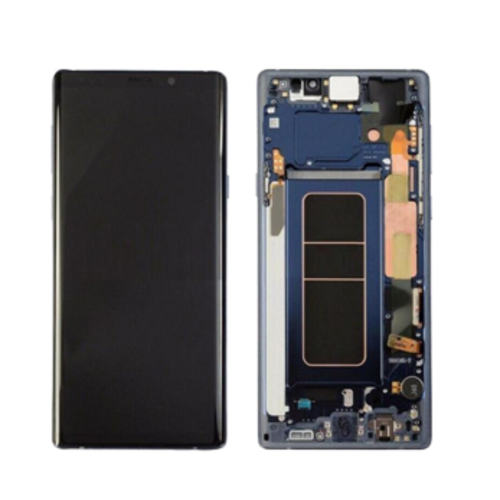
That distinction changes the questions a wholesale buyer must ask. “Hard OLED or Soft OLED?” is meaningful only after we know whether the model is flat or curved. “Incell or OLED?” is meaningful only after we verify what the phone used when it left Samsung. “Original New or Refurbished?” is about the source and treatment of the display panel, not simply about brightness or packaging.
I use four terms to describe the facts behind a Samsung grade:
- Panel source: unused original-source, recovered original, or aftermarket.
- Panel structure: flexible OLED, rigid OLED, or LCD/in-cell construction.
- Processing history: new assembly, re-glassed and re-laminated, or newly manufactured aftermarket part.
- Installation format: already assembled with a compatible middle frame, or supplied without frame.
This is why I do not accept a buying list that says only “Samsung original quality.” It does not tell me whether the buyer expects an unused service-pack-style assembly, a refurbished original panel, or an aftermarket panel intended to reproduce the original device’s behavior. The ambiguity is not cosmetic; it can change fit, handling, supply availability, and the technician’s installation process.
The practical rule is simple: lock the exact model first, identify its original display family second, then compare only the grades that can physically and commercially exist for that model.
What Are the Seven Samsung Screen Grades?
When I grade a Samsung request, I do not force every model into seven available choices. I use the seven-grade map as a vocabulary, then remove options that do not match the phone’s panel structure or the current supply program.
Short answer: the seven working grades are Original New, Original Refurbished, Soft OLED, Hard OLED, factory-spec incell, Incell FHD, and TFT.
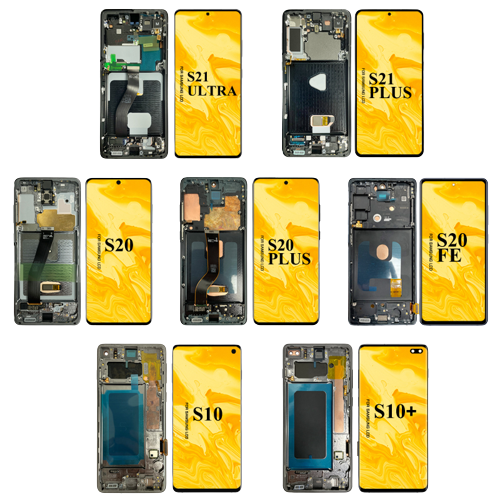
| Grade | Panel source or construction | Typical fit | Curved OLED | Flat AMOLED | LCD-based models |
|---|---|---|---|---|---|
| Original New | Market term for an unused original-source panel or assembly | Model dependent; verify the exact assembly | Yes | Yes | Model dependent |
| Original Refurbished | Original display panel with replaced outer glass and OCA | S, Note, selected A | Yes | Yes | Usually not the buying logic |
| Soft OLED | Aftermarket flexible OLED | Curved or flexibility-sensitive S/Note; standard-size and large-size variants may differ | Yes | Possible but not always necessary | No |
| Hard OLED | Aftermarket rigid OLED | Compatible flat AMOLED A models | No | Yes | No |
| Factory-spec incell | Incell option matched to compatible original LCD specification | LCD-based Galaxy A | No | No | Yes |
| Incell FHD | Cost-optimized aftermarket LCD/in-cell option | Supported LCD-based models | No | No | Yes |
| TFT | Cost-controlled aftermarket LCD option | Supported LCD-based models | No | No | Yes |
Original New
Original New is a market grade name for an unused original-source display panel or assembly. I include it here to explain how buyers may encounter the term, not as a statement. Exact packaging and part-number expectations still need to be written into an inquiry; “original” by itself is not a complete specification.
Galaxy Z Fold and Flip require a foldable-specific sourcing category. I do not map flat-screen aftermarket labels onto foldable assemblies or imply that a familiar grade exists when the construction is different. I still confirm the exact Fold or Flip generation, regional variant where relevant, and frame configuration because foldable assemblies are not interchangeable simply because they share the Z family name.
Original Refurbished
Original Refurbished retains the original display panel while replacing the damaged outer glass and re-laminating the assembly with new optical adhesive. The valuable component—the working original OLED panel—is kept. The quality risk shifts to the glass, cleaning, alignment, OCA lamination, edge finishing, and final testing.
This grade is important in the Galaxy S and Note supply market because it preserves original-panel display behavior while using recovered panels that can be rebuilt. It must not be confused with a pulled screen, which is removed and resold without the same re-glassing process, or with an aftermarket OLED, whose display panel itself is newly manufactured outside the original supply stream. I explain that distinction in depth in what a refurbished Samsung screen actually means.
Soft OLED
Soft OLED is an aftermarket flexible OLED. Its flexible substrate makes it the relevant aftermarket construction for curved and edge-shaped models where a rigid panel cannot follow the required geometry.1 It is not “soft” because the display surface feels soft; the term refers to the flexible OLED structure underneath the cover glass.
I confirm more than the grade name before quoting Soft OLED. The exact model, curve geometry, touch behavior, frame option, current batch specification, and active display area all matter. Soft OLED is the main aftermarket conversation for many S and Note models, but availability should never be generalized from one model to the whole series.
For Galaxy S and Note Soft OLED, the visible display area creates another buying decision. Much of the market has historically used a slightly smaller active display area because the standard-size version offered the more workable cost position. A large-size, often called 1:1-size, version preserves a fuller viewport but costs more. Before the second half of 2025, that premium could be so large that the price approached the level buyers normally associated with original-panel grades, so small-size versions represented a very large share of market demand. Since the second half of 2025, the gap has narrowed materially in our sourcing conversations. Large-size Soft OLED is now a strong option for buyers who value a more original-like visible area and can accept the remaining premium. The purchase order should state standard-size or large-size explicitly; “Soft OLED” alone is incomplete.
Hard OLED
Hard OLED is an aftermarket OLED built on a rigid substrate.2 It is best understood as a construction choice for compatible flat AMOLED models, especially within the Galaxy A family. A lower cost does not make a rigid panel compatible with a curved assembly; the physical shape sets the boundary.
In our current buying framework, Hard OLED is an A-series option for compatible flat AMOLED models. I do not present Hard OLED as an S- or Note-series alternative; those families follow flexible-panel choices instead. Within the compatible A-series group, the right comparison is against the buyer’s target market, display expectations, durability requirements, and return-control process—not against a grade that cannot physically fit.
Factory-Spec Incell
Factory-spec incell is the label we use for an incell option intended to match the original panel type and specification of compatible LCD-based Galaxy models. It does not mean Samsung has authorized or certified the part, and I avoid using the standalone term “OEM” in a purchase order because suppliers use that word inconsistently.
For a phone that originally shipped with an LCD-family display, matching that original display family is not a downgrade from an imaginary OLED version. It is the technically corresponding choice. The model must still be checked because resolution, connector, cutout, brightness behavior, and frame fit are model-specific.
Incell FHD
Incell FHD describes a supported aftermarket LCD option where an FHD in-cell grade exists. It is a sourcing category, not a promise that every Galaxy A model has the same resolution or construction. I write the exact model and required specification beside the grade so that “FHD” does not become a substitute for part identification.
This grade can serve buyers balancing display specification and cost in LCD-based repair markets. The receiving inspection still needs to cover touch response, image uniformity, connector fit, cutouts, and frame alignment.
TFT
TFT is the most cost-controlled LCD option in this map. It can be commercially useful for price-sensitive repair programs, but the buyer should define what is acceptable for brightness, viewing angle, color, touch response, thickness, and fit rather than assuming every TFT batch behaves alike.
I keep TFT out of AMOLED-only model discussions unless there is a specifically engineered compatible assembly that the buyer has deliberately chosen and tested. A grade name cannot override the phone’s mechanical and electrical requirements.
Why Doesn't Every Galaxy Model Have an OLED Option?
When I inspect a mixed Galaxy A list, I check the original panel family model by model before I classify the requested grade. This step catches the most common Samsung sourcing mistake: assuming every newer or more valuable-sounding A-series model must be AMOLED.
Short answer: many Galaxy A models originally use an LCD-family display, so a supposed same-spec “OLED upgrade” is not part of the normal grade map for those models.
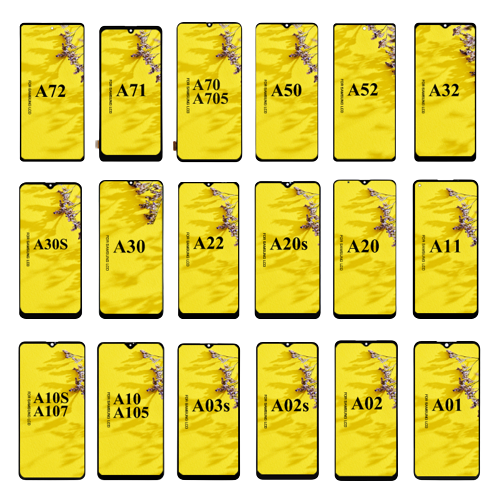
The model name is not enough to predict the panel. Published device specifications place the Galaxy A14 5G in the PLS LCD family while the Galaxy A15 uses Super AMOLED.3 They also separate the Galaxy A20 with Super AMOLED from the Galaxy A20s with TFT. These are not small naming details; they put the phones in different replacement-screen supply categories.
| Model-name trap | Original display family | What I write on the buying list |
|---|---|---|
| Galaxy A14 vs A15 | A14 5G: LCD family; A15: Super AMOLED | Full model plus network variant; never “A14/A15 screen” |
| Galaxy A20 vs A20s | A20: Super AMOLED; A20s: TFT | Exact suffix; AMOLED and LCD grades separated |
| Galaxy A22 4G vs A22 5G | 4G: Super AMOLED; 5G: TFT | Network variant written beside every line |
The A22 pair is equally important. Published specifications separate the Galaxy A22 4G with Super AMOLED from the Galaxy A22 5G with TFT.4 If a spreadsheet drops “4G” or “5G,” the grade request can become technically wrong before any supplier sees it.
Our current Samsung catalog contains a broad LCD-based A-series group that includes A02/A02s, A03 variants, A04 variants, A05/A05s, A06, A07, A11, A12, A13, A14, A20s, A21, A22 5G, A23, and A32 5G entries. It also contains AMOLED A-series groups where Original Refurbished or Hard OLED can be relevant. I treat this as an internal sourcing map, then verify the precise model against current manufacturer specifications and the supplier’s part reference before confirming an order.
The buying lesson is not to memorize one long model list. It is to build a control step: every Samsung line must contain the exact model identifier, network variant when it changes the device, original panel family, requested grade, and frame format.
How Does Grade Availability Change Across Galaxy Series?
When I review current catalog coverage, I see different grade ecosystems rather than one Samsung-wide assortment. Galaxy A spans both LCD and AMOLED devices; Galaxy S and Note concentrate around original refurbished and flexible OLED; Galaxy Z requires a specialized foldable-assembly discussion.
Short answer: the series name narrows the likely grade family, but only the exact model determines what can be ordered.
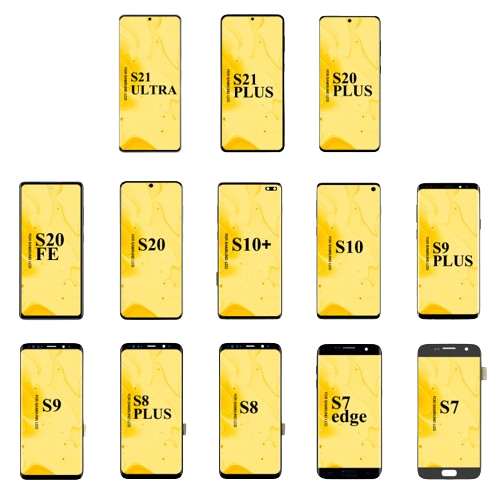
| Series | Dominant sourcing discussion | Current with-frame share | Main control point |
|---|---|---|---|
| Galaxy A | Hard OLED, refurbished, factory-spec incell, Incell FHD, TFT | About 78% | Verify LCD vs AMOLED by exact model |
| Galaxy S | Original Refurbished and Soft OLED | About 69% | Verify curve, frame, and grade availability |
| Galaxy Note | Original Refurbished and Soft OLED | Most current listings | Do not infer from S-series naming |
| Galaxy Z | Foldable-specific assembly sourcing | 100% of current listings | Exact Fold/Flip generation and assembly |
These percentages describe our current internal catalog snapshot, not a universal industry ratio and not a permanent stock promise. The underlying catalog currently contains 344 Samsung screen entries: 158 Galaxy A, 148 Galaxy S, 28 Note, and 10 Galaxy Z entries. Because models and batches change, I use the data to guide the first conversation and then confirm live availability.
Galaxy A requires the most careful classification because the same series includes LCD-based and AMOLED devices. Galaxy S and Note buying discussions usually center on Original Refurbished and Soft OLED, with current supply varying heavily by generation and exact model. Note should remain its own model family in the buying file. Galaxy Z requires a foldable-specific approach; I do not extrapolate a normal flat-screen grade onto it.
This series map also prevents a common sales mistake: presenting a seven-row price ladder for every phone. A good supplier response should remove impossible grades, explain why they are impossible, and quote only the configurations that correspond to the model.
How Should You Decide Between With Frame and Without Frame?
When I prepare a quote, I keep frame configuration as a separate field from grade. A refurbished original panel can be supplied with a compatible frame on some models, while the same grade may also exist without frame. Combining the fields into one vague product name makes comparison difficult.
Short answer: choose with frame for a more installation-ready assembly; choose without frame only when the repair bench can control separation, cleaning, alignment, and bonding.

A with-frame screen arrives assembled to a compatible middle frame.5 It reduces the preparation needed on the old frame and gives the technician a more repeatable replacement sequence. A without-frame screen is the display assembly alone. The technician must remove the damaged panel from the original frame, clean the bonding surface, align the replacement, and control the adhesive or lamination process.6
In our current Samsung screen catalog, 257 of 344 entries—about 75%—are listed as with-frame assemblies. This does not prove that with-frame is right for every buyer. It shows that frame configuration is a central Samsung procurement variable and that many current listings favor the installation-ready form.
I ask about technician capability before recommending frameless parts. Equipment, bench discipline, model volume, training, and the buyer’s tolerance for rework all matter. The unit line price alone cannot measure labor or installation exposure. The full decision process is covered in Samsung screen with frame versus without frame.
How Do I Match a Samsung Grade to My Market?
When I match a grade to a market, I ask what the buyer is trying to keep consistent: original-panel behavior, technician workflow, assortment breadth, or a defined cost position. I then exclude grades that violate the model’s technical boundary.
Short answer: start with a non-negotiable performance and installation target, then select the lowest-risk grade that meets it for each exact model.

For a multi-location repair chain, repeatable installation and written receiving standards often matter more than carrying every theoretical grade. With-frame Original Refurbished or Soft OLED may be appropriate for supported S-series programs, while LCD-based A models need their own incell/TFT specification rather than an OLED label.
For a regional distributor, assortment design may be the priority. I separate fast-moving models by panel family and carry intentional good/better/best positions only where those positions technically exist. A three-grade assortment for one A model should not be copied blindly to the next A model.
For a highly price-sensitive market, Incell FHD or TFT may be deliberate choices on supported LCD models. I still set a floor for touch response, brightness consistency, fit, connector quality, and batch inspection. “Price market” is not permission to remove the acceptance criteria.
For buyers serving premium repairs, the grade must state whether the requirement is for an unused or refurbished original-source panel. This is a specification distinction, not a stock promise. The purchase order should state frame format and define how cosmetic condition and refurbishment workmanship will be inspected.
The Samsung screen wholesale page provides the current series, grade, and frame structure. A quote still begins with an exact buying list because model-specific availability can change.
What Should Be Written on a Purchase-Ready Samsung Screen List?
When I receive a spreadsheet with only marketing model names, I return it for clarification before treating it as quote-ready. This pause prevents a fast quotation from becoming a slow claim later.
Short answer: every line needs model identity, variant, original panel family, requested grade, frame configuration, and quantity.
| Required field | Example format | Why it matters |
|---|---|---|
| Exact model | Galaxy A22 5G / model code if available | Separates phones with similar commercial names |
| Region or network variant | 4G or 5G when applicable | Can change the original display family |
| Original panel family | LCD/TFT family or AMOLED | Sets the technical grade boundary |
| Requested grade | Original Refurbished, Soft OLED, Hard OLED, incell, or TFT | Removes “original/OEM/copy” ambiguity |
| Frame format | With frame or without frame | Defines installation scope and quote structure |
| Color or frame detail | As required by the exact model | Prevents assembly mismatch |
| Quantity | Per exact model-grade-frame combination | Makes availability and MOQ review possible |
I also ask the buyer to state whether substitutions are allowed. If Soft OLED is unavailable, should the supplier hold the line, quote Original Refurbished separately, or stop and ask? Silent substitution is not an acceptable sourcing rule. The answer belongs in the buying instruction before the order is confirmed.
Finally, I retain a tested reference unit or approved sample standard for recurring models where practical. Written grade names are necessary, but receiving teams make better decisions when the visual, touch, fit, and assembly expectations are tied to something concrete.
Conclusion
Samsung screen sourcing becomes manageable when the classification follows the product’s engineering. The exact Galaxy model determines the original panel family. That panel family limits the possible grades. The buyer’s repair process determines whether with-frame or without-frame is practical. Only after those facts are fixed does a commercial comparison become meaningful.
The seven-grade map is useful because it replaces vague “original/OEM/copy” language with inspectable categories. It is not a promise that every model has seven options. I use it to exclude impossible choices, expose model-name traps, and write a buying list that a supplier and receiving team can interpret the same way.
Frequently Asked Questions
What is the best Samsung screen grade?
There is no single best grade for every Galaxy model. “Original New” is a market term for an unused original-source category, not a universal availability claim. Original Refurbished may be the practical original-panel choice for many S and Note models, while LCD-based A models need a matching incell or TFT-family specification rather than an imaginary OLED upgrade.
Is Original Refurbished the same as a pulled Samsung screen?
No. Original Refurbished normally keeps a working original display panel and replaces the damaged outer glass through cleaning and OCA re-lamination. A pulled screen is removed from another device and resold without necessarily going through that re-glassing process.
Can Hard OLED be used on Galaxy S or Note models?
Not in our current buying framework. Hard OLED is an option for compatible flat AMOLED models in the Galaxy A series; I do not present it as an S- or Note-series alternative. S and Note sourcing follows flexible-panel choices such as Soft OLED or model-specific original-panel categories.
Does every Galaxy A phone use an LCD screen?
No. Galaxy A includes both LCD-based and AMOLED models. A14 5G and A20s are LCD-family examples, while A15 and A20 are AMOLED examples. Always verify the exact model and network variant.
What does factory-spec incell mean?
It is our catalog label for an incell option intended to match the original display family and specification of a compatible LCD-based model. It does not imply Samsung authorization, and it should always be tied to an exact model specification.
Should wholesale buyers choose Samsung screens with frame?
With-frame assemblies suit buyers who prioritize a more repeatable installation process and less frame preparation. Without-frame screens suit repair benches that can control separation, cleaning, alignment, and bonding. The right choice depends on technician capability and model economics.
What information is needed for a Samsung screen quote?
Provide the exact model, regional or network variant where relevant, required grade, with-frame or without-frame format, color or assembly detail, and quantity per configuration. State whether substitutions are allowed.
"Ultra-low Power AMOLED Displays for Smart Wearable Applications", https://arxiv.org/html/2503.08137v1. Technical studies of flexible OLEDs describe bendable substrates as enabling curved display architectures, whereas rigid-substrate panels are constrained by their planar construction. Evidence role: mechanism; source type: paper. Supports: Research explaining how flexible substrates enable bending or curved display structures and how rigid substrates impose geometric constraints.. Scope note: The cited mechanism supports display geometry generally and does not by itself verify compatibility with a particular Galaxy model or replacement assembly. ↩
"GX vs DD vs JK vs RJ: 2026 iPhone Aftermarket Screen Tier Guide", https://fizonparts.com/iphone-aftermarket-screen-brands-gx-dd-jk-rj-compared/. OLED display literature distinguishes rigid-substrate devices from flexible OLEDs, whose substrate and encapsulation structures are designed to tolerate bending. Evidence role: definition; source type: paper. Supports: Technical literature distinguishing rigid-substrate OLED devices from flexible-substrate OLED devices.. Scope note: Academic sources may not use the commercial aftermarket term 'Hard OLED' even when describing the corresponding rigid construction. ↩
"Samsung Galaxy A15 - Wikipedia", https://en.wikipedia.org/wiki/Samsung_Galaxy_A15. Published device specifications identify the Galaxy A14 5G as using an LCD-family display and the Galaxy A15 as using a Super AMOLED display. Evidence role: case_reference; source type: institution. Supports: Official or independently documented display specifications for the Galaxy A14 5G and Galaxy A15.. Scope note: Specifications may vary by regional or network variant, so the cited models should be matched to the exact device designation being ordered. ↩
"Samsung Galaxy A22 5G (Android 11.0) Specifications - Device guides", https://deviceguides.ee.co.uk/samsung/galaxy-a22-5g-android-11-0/specifications/. Device specifications distinguish the Galaxy A22 4G, specified with a Super AMOLED display, from the Galaxy A22 5G, specified with a TFT display. Evidence role: case_reference; source type: institution. Supports: Published technical specifications for the 4G and 5G Galaxy A22 variants.. Scope note: The evidence supports the named variants but does not eliminate the need to verify regional model codes and connector or frame compatibility. ↩
"Manual2Skill: Learning to Read Manuals and Acquire Robotic Skills ...", https://arxiv.org/html/2502.10090v2. Repair documentation commonly distinguishes a display assembly supplied with its supporting midframe from a screen-only assembly requiring transfer to the original frame. Evidence role: definition; source type: education. Supports: Repair documentation defining a screen assembly with frame and distinguishing it from a screen-only or frameless assembly.. Scope note: Part names and included components can vary among suppliers, so the purchase order should specify the included frame and assembly components. ↩
"(PDF) REPAIR AND MAINTENANCE OF MOBILE CELL PHONES ...", https://www.academia.edu/42996359/REPAIR_AND_MAINTENANCE_OF_MOBILE_CELL_PHONES_Mobile_Phone_Repair_and_Maintenance. Display-repair procedures describe frameless replacement as involving separation from the original support, adhesive-surface preparation, alignment, and controlled bonding or lamination. Evidence role: mechanism; source type: education. Supports: Repair manuals or technical training materials describing the steps required to transfer or laminate a display without a frame.. Scope note: The exact steps and equipment depend on the model, adhesive system, and repair method used by the technician. ↩