If you're buying iPhone screens in bulk and still unsure which brand to stock, you're not alone. Most buyers I speak with get stuck on this exact question — and pick wrong.
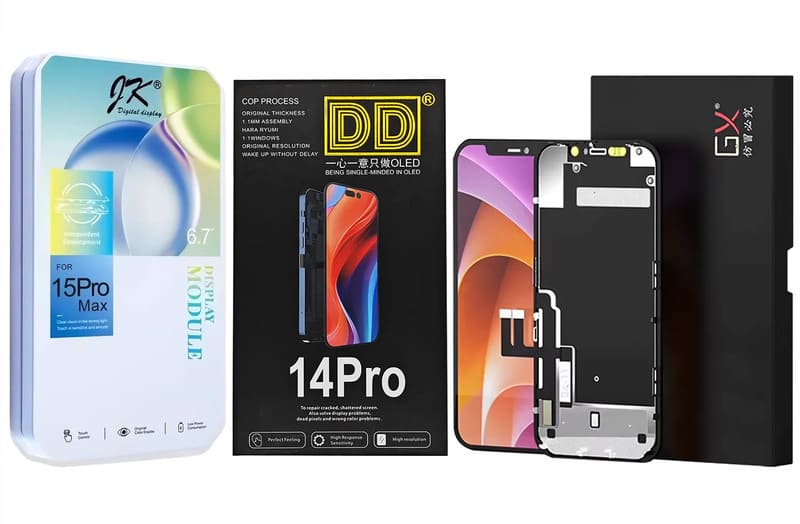
If you are choosing between GX and DD displays, start with the same iPhone model and the same screen grade. GX is usually easier to position as a broad premium aftermarket option, while DD is often stronger when the buyer cares most about Soft OLED display feel and current-batch stability. For wholesale buyers, the right answer is not simply GX or DD. It depends on grade, batch, customer expectation, and after-sales risk.
A lot of buyers come to me asking which brand is "the best." I understand why — it feels like the right question. But after working with wholesale accounts across Australia, Europe, North America, and Latin America1, I've seen enough to know that the question itself often leads buyers in the wrong direction.
GX and DD both make Hard OLED and Soft OLED products, but one brand does not automatically cover every iPhone model in every grade. For example, seeing every model on a supplier's price list under one brand name does not mean the factory actually produces all of those models in that grade. This is one of the easiest details for new buyers to miss.
The better question is: which grade and brand combination fits your market, your customer expectations, and your inventory model?
Once you have chosen the grade and brand mix for your market, use our iPhone screen wholesale supply page to check model coverage, MOQ, and current sourcing options.
Before Brand: Have You Decided on Grade Yet?
This is the part most buyers skip, and it causes real problems down the line.
When buyers ask me "which is better, GX or DD?" without telling me the grade they're comparing, I can't give a useful answer. GX and DD both make Hard OLED and Soft OLED products. Comparing one brand's Hard OLED to another brand's Soft OLED is not a clean brand comparison — it's a grade comparison. That's a completely different decision.
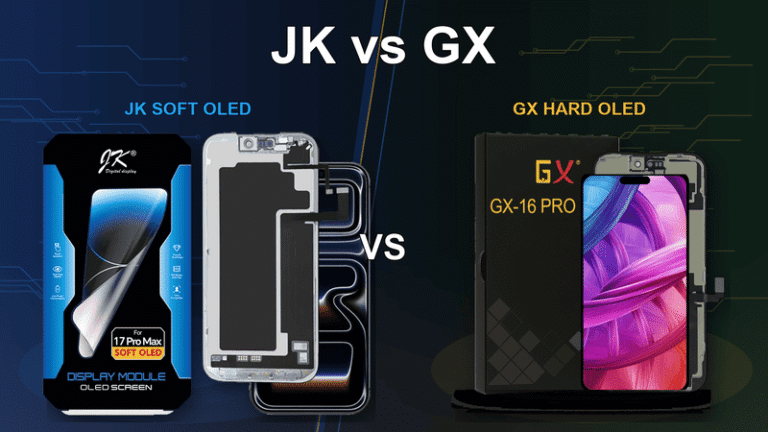
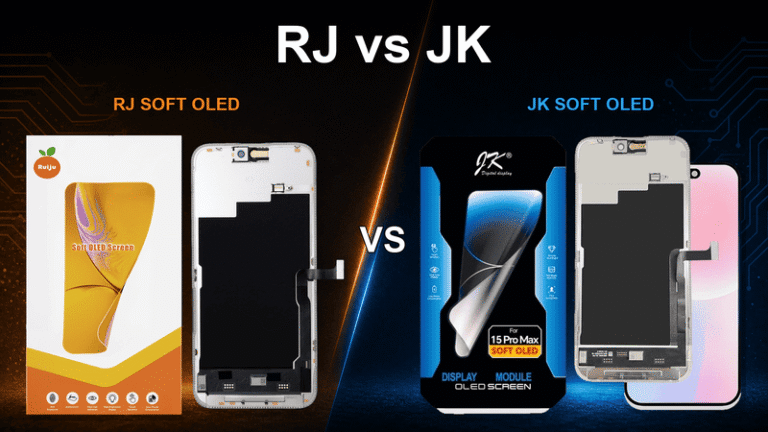
For a broader overview of GX, DD, JK, and RJ together, you can also read my iPhone screen brand guide for wholesalers..
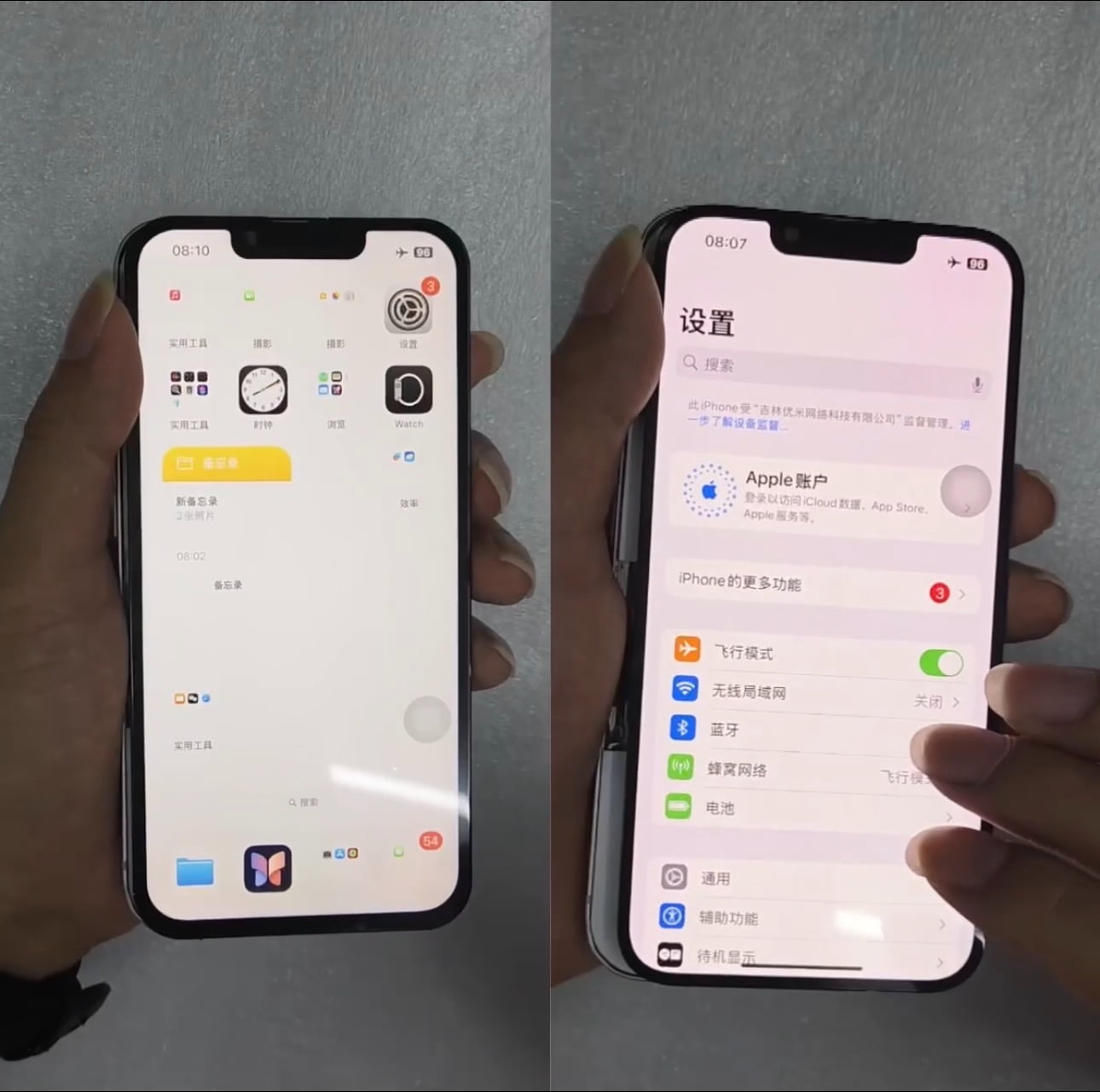
Before you pick a brand, you need to know which grade tier you're buying in. Here's a simple breakdown:
What Are the Main Grade Tiers?
| Grade | Display Tech | Typical Use Case | Price Range |
|---|---|---|---|
| INCELL | LCD-based | Budget repairs, price-sensitive markets | Lowest |
| Hard OLED | Rigid OLED | Mid-tier OLED option for buyers who want OLED at a more controlled cost | Mid |
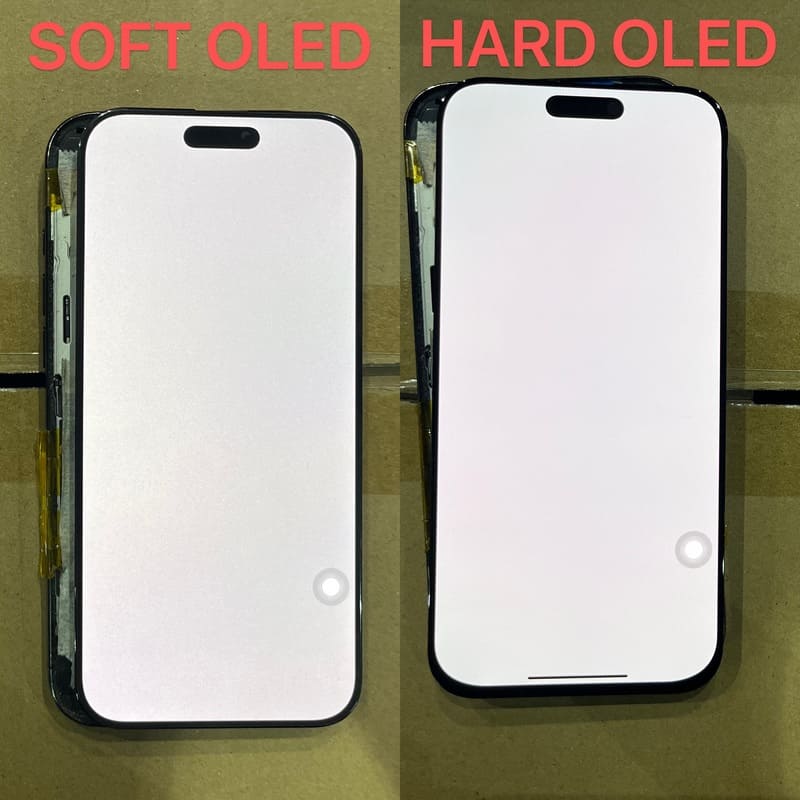
| Soft OLED | Flexible OLED | Quality-focused markets, flagship models, and buyers who care more about display feel | Higher |
| Original Refurbished | Genuine Apple panel | Premium repair shops, high-expectation buyers | Highest |
Each grade tier has its own quality ceiling. No brand in the INCELL tier can match the display output of a well-made OLED. So if your customer base is expecting OLED-level brightness and color accuracy and you're shipping them INCELL — that's a grade mismatch, not a brand problem.
Of course, this does not include another problem I still see in the market: some sellers put INCELL screens into GX or DD packaging and sell them as Hard OLED or Soft OLED2. Don't laugh — this really happens. That is why grade verification matters before brand selection.
Once you've decided on grade, then brand selection becomes meaningful. GX, DD, JK, and RJ all operate across different grade tiers. Their differences — model coverage, batch consistency, color calibration, touch response, and supplier control — only matter once you're comparing products at the same level. This is the starting point. Everything below assumes you've made the grade decision and are now choosing between brands within the same tier.
What Actually Separates GX, DD, JK, and RJ?
Most buyers assume these four brands are roughly equal with slightly different price tags. That's not how it works in practice.
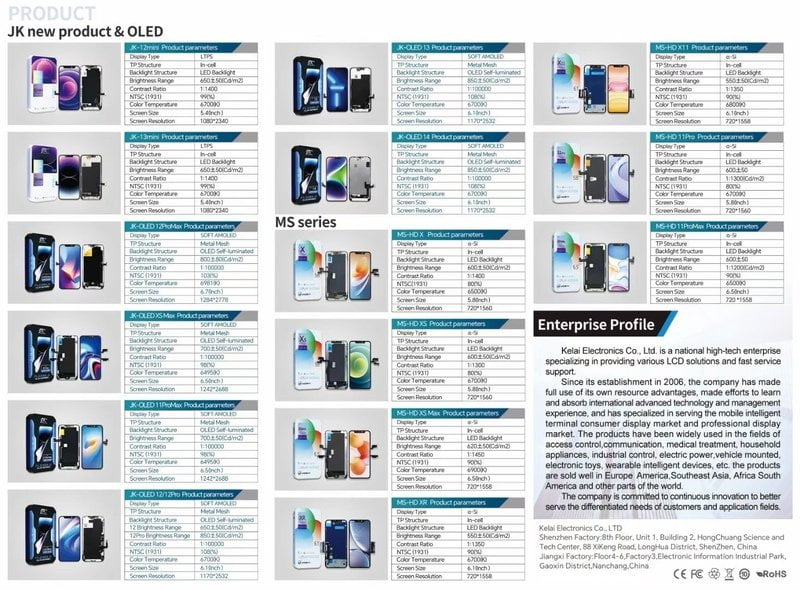
From what we see across wholesale accounts in multiple markets, the differences that actually affect your business are available grades, model coverage, batch consistency, color calibration accuracy, and how the screens perform over 30-90 days of real use in customer hands.
These differences don't always show up on a spec sheet. They show up when you reorder the same model, compare batches, and listen to what repair shops say after installation.
How I Make These Recommendations
I do not make brand recommendations from a price list alone. A price list only tells you what a supplier wants to sell. It does not prove the real grade, the real factory source, or whether that model is stable in repeat orders.
When I judge whether GX, DD, JK, or RJ is a good fit for a buyer, I usually look at:
- sample testing before bulk orders
- whether the same grade stays consistent in repeat orders
- customer complaints after installation
- touch response and edge sensitivity
- brightness, color, and display feel
- frame fit and connector alignment
- whether the brand actually covers that model and grade
- after-sales feedback from recent batches
- whether the product helps the buyer's inventory turn faster
This is why two buyers can ask me the same question and get different answers. A repair shop selling to premium customers in Australia may need a different inventory mix from a wholesaler selling fast-moving budget stock in Colombia.
How Do the Four Brands Compare in Practice?
Here's how I'd describe each brand based on buyer feedback and sourcing patterns we see regularly:
| Brand | Available Grades | Batch Consistency | Best-Fit Market Type | After-Sales / Stocking Notes |
|---|---|---|---|---|
| DD | Hard OLED, Soft OLED | Very stable now; before 2024 it was often the top reference point | High-expectation buyers, especially for newer models | Strong option to test for premium customer groups and latest models |
| GX | INCELL, Hard OLED, Soft OLED | Very good overall | Mixed markets, broad coverage, buyers who need a balanced lineup | Strong all-around option when model coverage and sales familiarity matter |
| JK | INCELL, Hard OLED, Soft OLED | Very good overall; INCELL on older X-11 Pro Max models can be slightly weaker | Repair shops and wholesalers competing on price; OLED/Soft OLED can compete at the same level as GX/DD | INCELL is useful for price competition; OLED lines should be judged model by model |
| RJ | INCELL, Hard OLED, Soft OLED | Very good overall; INCELL on older X-11 Pro Max models can be slightly weaker | Buyers who want stronger margin and do not need a famous brand story | Often gives better profit room; useful when the buyer wants to protect his own customer relationship |
Need wholesale supply after comparing brands? Visit our iPhone screen supplier page to check model coverage, quality options, MOQ, and B2B shipping terms.
I want to be clear: this is field-based guidance from buyer conversations, repeat orders, and after-sales feedback. It should still be verified with current batch samples before bulk orders. Individual batches can vary. Your results will also depend on which model you're buying, your specific market, and how your customers use the devices.
That said, the pattern is consistent enough that I use it as a starting point when I'm helping a new buyer decide where to begin.
The biggest mistake I see: a buyer receives a very complete supplier price list. Every iPhone model is listed under DD packaging, every model looks available, and the price is surprisingly attractive. That should raise a red flag. DD does not cover every iPhone model in every Hard OLED or Soft OLED grade. The same kind of issue can happen with GX or JK. When a supplier uses one brand name to cover everything, it often means the packaging is doing more work than the product itself. Buyers may then spend the next few months dealing with inconsistent quality, unclear replacement responsibility, and customers who no longer trust the stock.
The second biggest mistake: a buyer in a price-sensitive market buys only premium DD stock when a mixed inventory would work better. In some markets, adding Hard OLED or using JK and RJ INCELL as supporting inventory can improve price competitiveness. If the buyer only stocks the premium option, he may lose price competitiveness without gaining anything meaningful in inventory turnover.
Neither mistake is about good or bad brands. Both mistakes are about mismatched expectations between grade, brand coverage, customer type, and market reality.
Which Brand Fits Which Market?
Let me break this down by market type, based on what we consistently see from wholesale buyers sourcing for these regions.
This is field-based guidance from buyer conversations, repeat orders, and after-sales feedback. It should still be verified with current batch samples before bulk orders.
High-Display-Expectation Customer Groups
In markets such as the US, Europe, Australia, Switzerland, Germany, and Ireland, there are many end customers who care deeply about display quality and want the replacement screen to feel close to original. That does not mean every buyer in these countries is high-end. It means repair shops and wholesalers serving this customer group need to be more careful with grade and brand selection.
For these customer groups, I usually point buyers toward DD as one of the first options to test — especially for newer models like iPhone 14, iPhone 15, and iPhone 16 series. DD's stability on recent batches is the main reason I put it in the first testing group3. When your customer expects a better display feel, inconsistency is expensive.
GX is also a solid option for these buyers, particularly where you need broader model coverage or where DD availability on a specific model is limited. GX performs well in most standard conditions and is a reasonable choice for buyers who want a balance of quality, coverage, and price.
These are starting points, not fixed rules. I adjust them based on the buyer's customer segment, repair price level, and inventory turnover target.
| Market | Recommended Starting Point | Rationale |
|---|---|---|
| USA | GX OLED or JK INCELL | The market is competitive and transparent; buyers often need both quality and price options |
| Germany / Switzerland | DD or GX | Many repair shops have strict display expectations and lower tolerance for inconsistent stock |
| Australia | DD or GX | Active repair and resale market, buyers often care about stable performance |
| France / Spain / Italy | GX, DD, or JK | Mixed market; buyers often need both upper-tier and competitive stock |
| Ireland / Poland | GX or JK | Cost-quality balance matters, and many buyers need practical inventory coverage |
Price-Sensitive or High-Volume Customer Groups
In price-sensitive or high-volume customer groups, price positioning matters more. End customers may be more accepting of slight display variation if the price point is right and the screen functions reliably. Quality still matters, but the inventory strategy is different.
For these buyers, JK is often a good fit. It has stronger market recognition than RJ, covers many practical repair use cases, and comes in at a price point that makes bulk buying easier.
If your buying plan is focused on price-sensitive repair channels, you can also review our wholesale JK iPhone screens page for current JK Incell, Hard OLED, and Soft OLED inventory.
RJ Incell and Soft OLED screens are a very good choice when your customer does not care strongly about the brand name printed on the package. RJ is not as famous as JK because RJ does not promote the brand as aggressively. But that can actually protect the buyer's interest. RJ screens do not carry a visible logo on the screen itself, so your customer or competitor cannot easily identify which brand you are using4. For some wholesalers and repair shops, that means better margin protection and less direct price comparison.
| Market | Recommended Starting Point | Rationale |
|---|---|---|
| Brazil | JK | Strong price sensitivity, JK hits the right cost-quality point |
| Colombia / Mexico | JK or RJ | Depends on whether the buyer needs brand recognition or margin protection |
| Argentina | JK | Price-driven market, mid-tier performs well |
| Southeast Asia | JK or RJ | Volume-focused, price is often a primary decision driver |
I do not want this section to sound like a fixed country-by-country rule. Every market has both high-end customers and budget customers now. A wholesaler or repair shop should not stock only one answer. The real work is building the right inventory mix for your own customers.
If you have reached this point and still feel unsure, that is normal. This is exactly the kind of situation where it helps to talk with a supplier who understands both product grades and market positioning. There is no universal best answer. There is only the answer that fits your customer base, your margin target, and your inventory turnover plan.
How to Think About Return Rate as a Real Cost
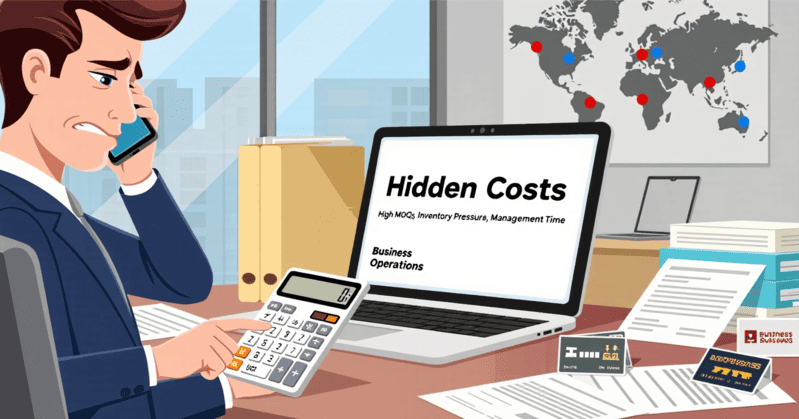
Most buyers track cost per unit. Very few track total cost per transaction — which includes return handling, rework labor, downstream customer credit, and the time spent managing complaints.
Here is a simple way to think about it.
A Basic Return Cost Model
Use your own numbers here. The example below is only to show how return cost changes the real buying decision. Say you're buying 500 units and your supplier offers you two options:
| Option | Unit Price | Estimated Return Rate | Returns on 500 Units | Rework / Credit Cost Per Return |
|---|---|---|---|---|
| Brand A (lower price) | $16 | 4% | 20 units | $10 per unit |
| Brand B (higher price) | $18 | 0.7% | 3.5 units | $10 per unit |
Brand A total cost: $8,000 + (20 x $10) = $8,200 Brand B total cost: $9,000 + (3.5 x $10) = $9,035
In this example, Brand B still costs more upfront. But the real gap is no longer just the $1,000 difference on the invoice. After return handling, the gap becomes $835. More importantly, Brand A creates about 20 problem units while Brand B creates about 3-4. That difference affects customer conversations, replacement planning, technician time, and how confidently you can reorder the same stock.
The numbers will vary for every business. But the principle holds: optimizing for unit price without factoring in return cost is an incomplete calculation.
This is why DD or GX may make sense for customer groups with higher display expectations, even when they carry a higher unit price. The financial difference may be smaller than it looks once return handling is included. And this is also why JK or RJ can make sense in more price-sensitive inventory plans, where faster turnover and stronger price positioning may matter more than choosing the highest-cost option.
I'm not telling you which answer to land on. I'm telling you to run the numbers with your actual return, rework, and inventory turnover costs before making a brand decision based on unit price alone.
FAQ
Should I choose GX or DD for high-end customers?
If your customers care most about display feel, color, and a more premium replacement experience, I would usually test DD and GX first. DD is often one of my first tests for newer models, while GX is a strong option when you need broader coverage or a more balanced lineup. I would not choose only by brand name. I would compare the current batch, the exact model, and the grade.
Is JK good enough for price-sensitive repair markets?
Yes, JK can be a strong option for price-sensitive repair markets, especially when the buyer needs market recognition and stable volume. For INCELL, JK is often easier to explain to customers than a less-known brand. For OLED and Soft OLED, I still suggest checking the exact model and batch before deciding.
Can I sell different iPhone screen brands in the same market?
Yes. In fact, many buyers should do this. One market can have premium customers, budget customers, and repair shops with different price levels. You can use GX or DD for higher-expectation customers, and JK or RJ for more competitive price points. The important thing is to give each brand a clear role in your inventory.
Should I choose brand first or grade first?
Choose grade first. Decide whether your market needs INCELL, Hard OLED, Soft OLED, or Original Refurbished. After that, compare brands within the same grade. If you choose the brand first, you may accidentally compare products that are not in the same tier.
Conclusion
GX, DD, JK, and RJ all serve a purpose — but they serve different stocking strategies. Decide your grade first, then match the brand to your market's quality expectations, price level, and inventory turnover plan. That's the decision framework that actually protects your margin.
For a broader brand-by-brand comparison, read my iPhone screen brand guide for wholesalers.
"Smartphone Repair Market Share Shows Strong Growth at 8%", https://www.businessresearchinsights.com/market-reports/smartphone-repair-market-117485. Market research on the global smartphone repair industry indicates a multi-billion-dollar aftermarket parts sector spanning North America, Europe, Asia-Pacific, and Latin America, with regional demand patterns influenced by device penetration rates, repair labor costs, and consumer price sensitivity. Evidence role: statistic; source type: institution. Supports: That the global aftermarket smartphone repair parts market is a substantial and geographically distributed industry, providing context for why regional sourcing strategies differ. Scope note: Specific market-size figures vary by research firm and methodology; the article's geographic claims are based on the author's own sourcing experience rather than on the cited market data. ↩
"Consumer Product and Retail Fraud - OCC", https://www.occ.gov/topics/consumers-and-communities/consumer-protection/fraud-resources/consumer-product-and-retail-fraud.html. Industry and consumer-protection bodies have documented instances of counterfeit or mislabeled electronic components in aftermarket supply chains, including mobile device parts; this broader pattern of component misrepresentation provides context for the author's claim that lower-grade screens are sometimes sold in higher-grade branded packaging. Evidence role: general_support; source type: institution. Supports: That mislabeling and fraudulent grading of aftermarket electronic components is a documented problem in the mobile device repair supply chain. Scope note: General counterfeit-parts documentation may not specifically address iPhone screen grade mislabeling; the specific claim about GX and DD packaging misuse is the author's own field observation and is not directly proven by general counterfeit-parts literature. ↩
"[PDF] OLED Manufacturing Challenges", https://www.energy.gov/sites/prod/files/2021/02/f82/ssl-rd21-spindler-challenges.pdf. OLED manufacturing processes involve multiple deposition and encapsulation steps sensitive to environmental and process variation, which can produce measurable batch-to-batch differences in luminance, color point, and touch-layer performance; this manufacturing reality supports the article's recommendation to verify current batch quality before committing to bulk orders. Evidence role: mechanism; source type: research. Supports: That OLED panel manufacturing involves process variables that can produce batch-to-batch variation in color calibration, brightness uniformity, and touch response, making batch testing a relevant quality-assurance practice. Scope note: Published manufacturing literature addresses OEM-scale production; batch variation characteristics of smaller aftermarket manufacturers may differ and are not directly documented in academic sources. ↩
"Private Label Branding (With Definition, Examples and Steps) - Indeed", https://www.indeed.com/career-advice/career-development/private-label-branding. Research on private-label and unbranded product strategies in wholesale and distribution contexts indicates that reduced brand visibility limits direct price comparison by downstream buyers, supporting the article's claim that unbranded screens can provide margin protection for wholesalers. Evidence role: mechanism; source type: research. Supports: That selling unbranded or private-label products reduces direct price comparability, which can protect distributor margins by limiting customers' ability to benchmark prices across suppliers. Scope note: General private-label pricing literature addresses consumer goods broadly; its applicability to the aftermarket mobile parts segment is contextual rather than direct. ↩